A quick guide to laboratory airflow, protection, and applications
Biosafety cabinets, Laminar flow Hood, and laboratory fume hoods may look similar, but they are designed for different purposes.
The key question when selecting laboratory equipment is:
What needs to be protected?
1. The Key Difference
| Equipment | Main Protection | Typical Application |
| Biosafety Cabinet (BSC) | Personnel + Product | Biological hazards |
| Laminar flow Hood | Product / Sample | Non-hazardous clean work |
| Fume Hood | Personnel / Chemical containment | Chemical hazards |
In simple terms:
Biosafety Cabinet → Biological Protection
Laminar flow Hood → Product Protection
Fume Hood → Chemical Containment
These three types of equipment should not be considered interchangeable. The airflow direction and containment principle are different.
2. Biosafety Cabinet: Biological Protection
A Biosafety Cabinet (BSC) is designed for work involving biological materials that may generate infectious aerosols or droplets.
A typical Class II BSC uses controlled inflow, HEPA-filtered downflow, and filtered exhaust or recirculation.
Simplified airflow:
Room Air → Front Inflow → HEPA → Downflow → Work Area → Exhaust / Recirculation
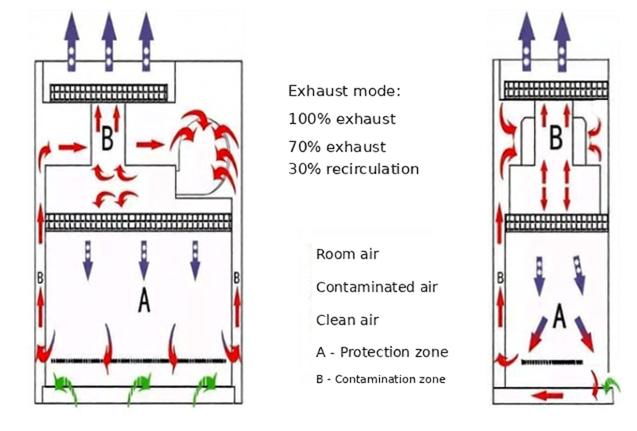
The inward airflow helps contain potentially contaminated air, while filtered downflow helps protect the work area. Class II BSCs are designed to provide personnel, product, and environmental protection when properly selected, installed, and operated.
Typical applications include:
- Microbiology
- Cell culture
- Infectious sample handling
- Molecular biology
- Aerosol-generating biological procedures
3. Laminar flow Hood: Product Protection
A Laminar flow Hood, is designed primarily to protect the product or sample from airborne contamination.
Filtered air moves through the work area in a unidirectional airflow.
Depending on the design, airflow may be:
Horizontal:
HEPA/ULPA → Work Area → Operator
Vertical:
HEPA/ULPA ↓ Work Area ↓ Front / Exhaust
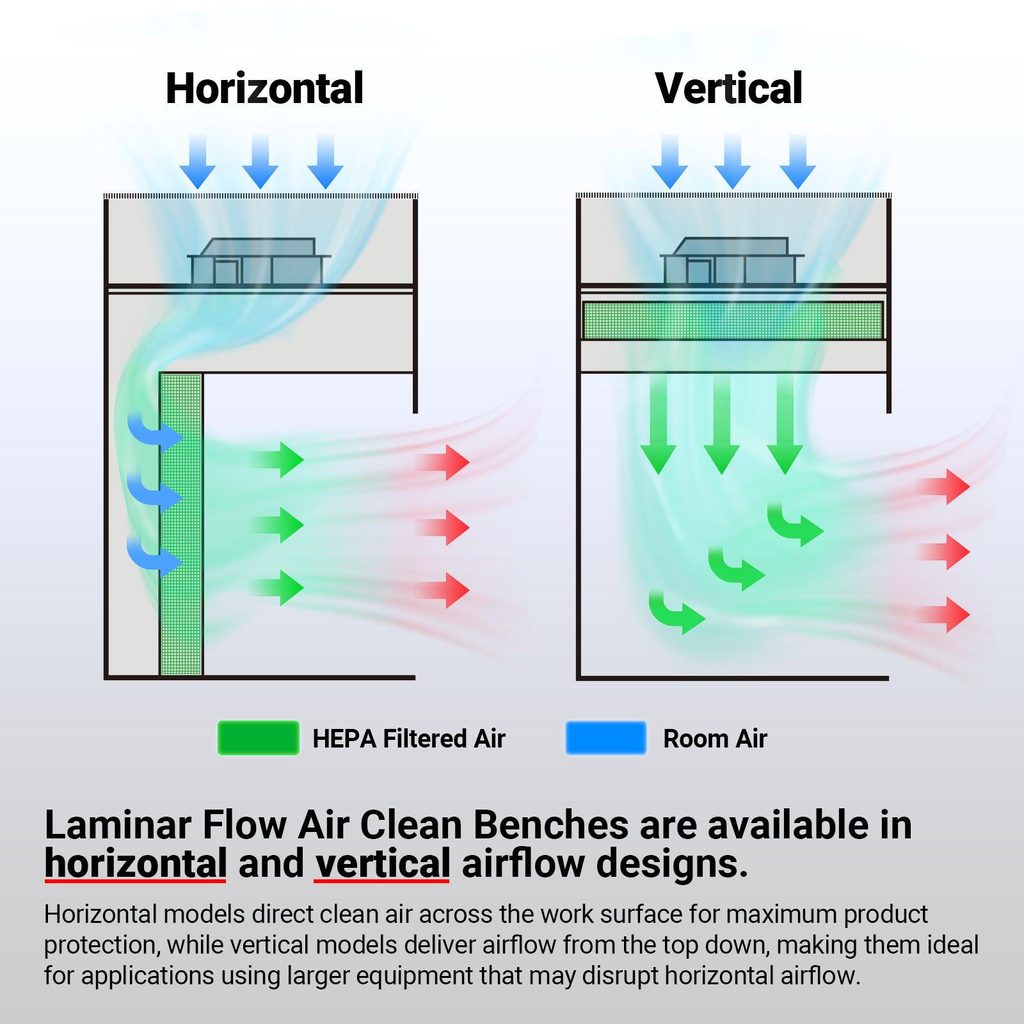
The critical point is:
A Laminar flow Hood protects the product — not the operator.
Therefore, it should not be used for infectious or hazardous biological materials. Several university laboratory-safety programs make this distinction explicitly.
Typical applications include non-hazardous sample preparation, sterile product handling, plant tissue culture, and medical-device assembly.
4. Laboratory Fume Hood: Chemical Containment
A Laboratory Fume Hood is primarily designed to control hazardous chemical vapors, fumes, gases, and aerosols.
The basic airflow is:
Room Air → Hood Opening → Work Area → Exhaust → Outside
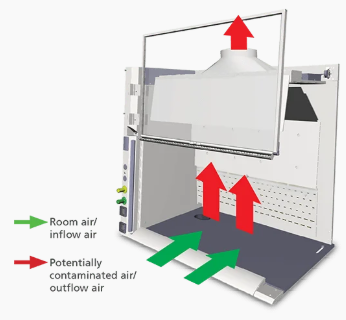
Unlike a conventional biosafety cabinet, a fume hood primarily relies on containment and exhaust ventilation.
Typical applications include:
- Organic solvents
- Corrosive chemicals
- Toxic chemicals
- Chemical reactions
- Hazardous vapors and gases
The airflow enters through the hood face and is pulled toward the exhaust system, away from the operator.
5. Quick Comparison
| Feature | Biosafety Cabinet | Laminar flow Hood | Fume Hood |
| Biological hazards | ✓ | ✕ | ✕ |
| Product protection | ✓ | ✓ | ✕ |
| Personnel protection | ✓ | ✕ | ✓ |
| Chemical vapor control | Application dependent | ✕ | ✓ |
| HEPA/ULPA filtration | Typically | Typically | Not the primary control |
| Main airflow | Inflow + Downflow | Unidirectional | Exhaust |
| Typical U.S. reference | NSF/ANSI 49 | ISO 14644 / applicable guidance | ANSI/ASHRAE 110 |
| European reference | EN 12469 | ISO 14644 / applicable guidance | EN 14175 |
6. Which One Do You Need?
Choose a Biosafety Cabinet when:
Biological hazards are involved.
Examples include infectious samples, microbial cultures, cell culture, and aerosol-generating procedures.
Choose a Laminar flow Hood when:
The main requirement is product or sample cleanliness and the work is non-hazardous.
Choose a Fume Hood when:
Hazardous chemical vapors, fumes, or gases need to be contained and exhausted.
If both biological and chemical hazards are present, cabinet selection requires additional assessment of the biological risk, chemical properties, quantities, exhaust configuration, and laboratory HVAC system.
Conclusion
Although these three laboratory workstations may look similar, their protection objectives and airflow principles are fundamentally different.
Remember:
Biosafety Cabinet = Protect People + Product
Laminar flow Hood = Protect Product
Fume Hood = Control Chemical Hazards
For equipment selection, start with:
Hazard → Protection Objective → Airflow → Application → Standard
The right cabinet is determined by the laboratory process—not simply by appearance or filter efficiency.