Another common optical design used in biochemistry analyzers is the beam-splitter optical system, also known as a post-dispersion optical path with dichroic beam splitters.
In this system, polychromatic light first passes through the cuvette, where part of the light is absorbed by the reaction solution.
The transmitted composite light then enters a beam-splitter module.
Inside the module, each dichroic beam splitter reflects a specific target wavelength by 90 degrees toward its corresponding bandpass filter and detector, while the remaining light continues to the next stage.
In this way, multiple wavelengths can be separated one by one through the optical structure itself, and each wavelength is detected by its own photodiode.
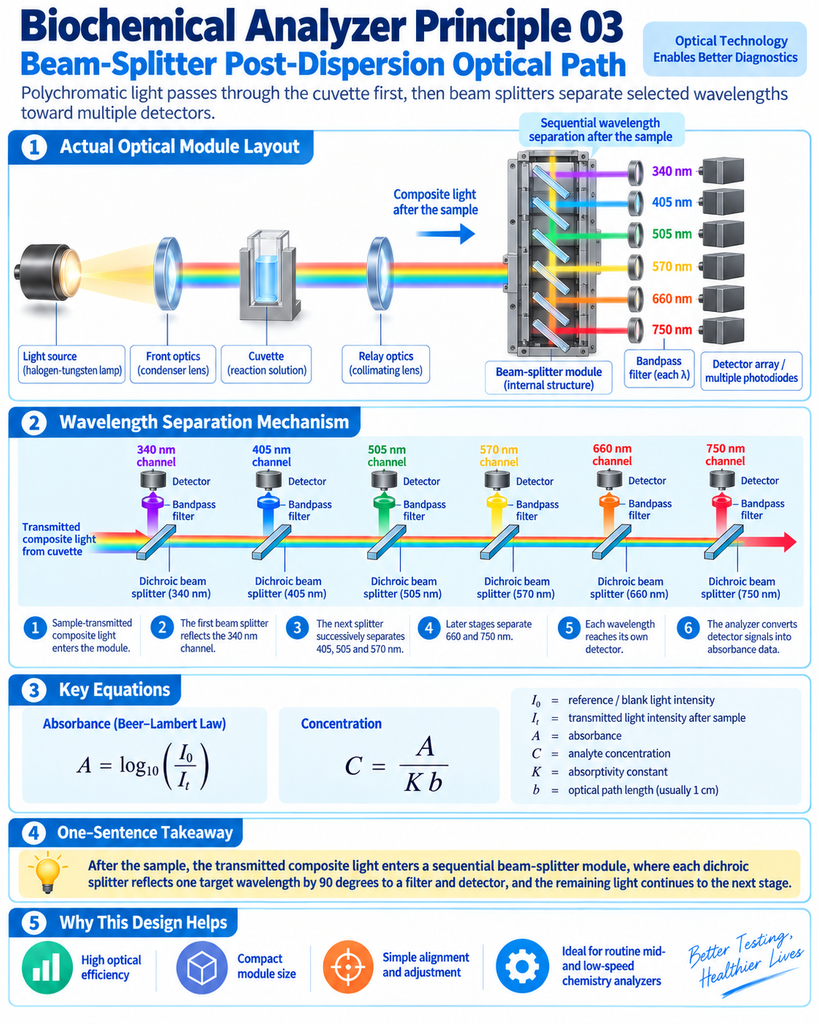
The analyzer then converts the detected optical signals into absorbance data based on the Beer–Lambert Law:
A = log₁₀(I₀ / Iₜ)
where I₀ is the reference light intensity and Iₜ is the transmitted light intensity after passing through the sample.
In simple terms:
Light Source → Cuvette → Beam Splitters → Filters → Detectors → Signal Processing → Result
Why is this design used?
- Simple optical structure
- Lower manufacturing cost
- Compact module design
- Suitable for low- to medium-speed analyzers
- Good choice for routine chemistry testing
Compared with high-speed grating-based systems, the beam-splitter optical path is more commonly used in analyzers where cost control, structural simplicity, and stable routine performance are important.
This design is widely used in low- and medium-throughput biochemical analyzers.
#BiochemistryAnalyzer #ClinicalChemistry #LaboratoryEquipment #IVD #BeamSplitter #OpticalSystem #MedicalLaboratory #LabTechnology #Spectrophotometry #LaboratoryTesting