In automated biochemistry analyzers, another common optical design is the grating optical system, especially in high-speed and high-throughput analyzers.
This design is often called a post-dispersive system.
Unlike the filter-wheel system, the light does not select a single wavelength before entering the cuvette.
Instead, the polychromatic light first passes through the reaction solution, and the transmitted light is then directed to a diffraction grating.
The grating separates the transmitted light into different wavelengths according to the diffraction principle.
These wavelengths are then received by a photodiode array (PDA) or related detector system.
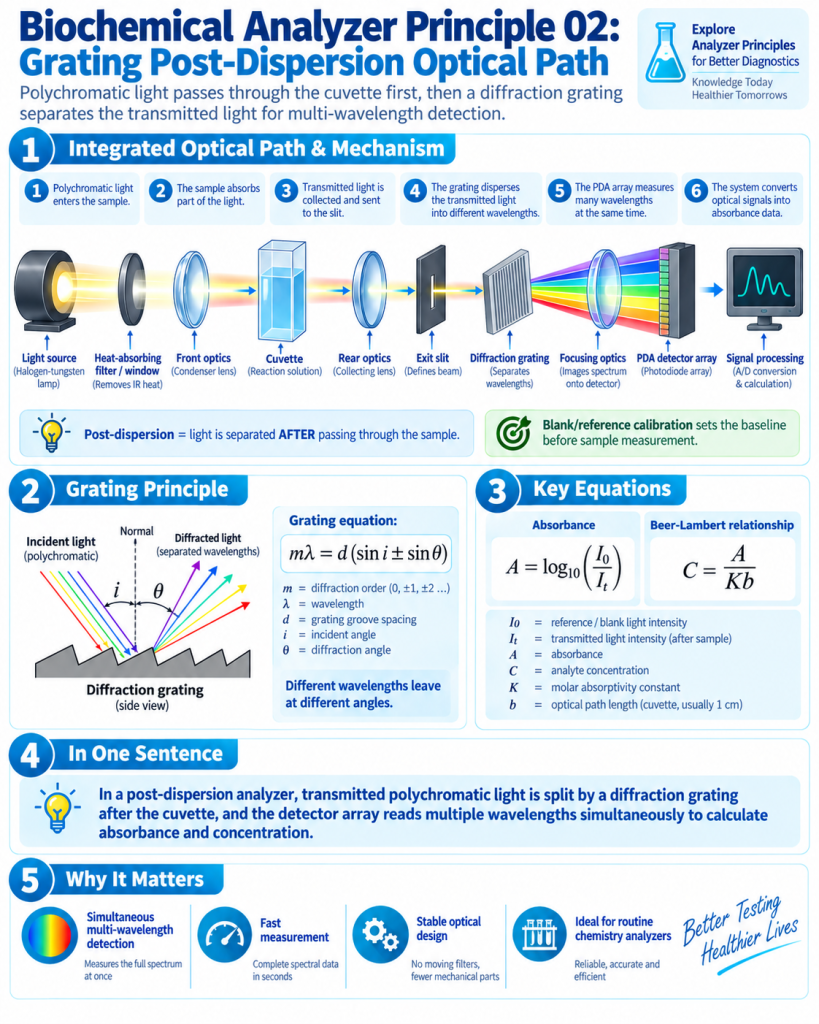
Because multiple wavelengths can be detected simultaneously, this optical structure is well suited for analyzers that require fast measurement speed, rapid data acquisition, and multi-wavelength analysis.
The analyzer compares the detected optical signal with the blank/reference signal and calculates absorbance based on the Beer–Lambert law.
This helps reduce the influence of the cuvette, solvent, reagent background, and other non-target factors.
In simple terms:
Light Source → Cuvette → Grating Dispersion → Photodiode Array Detector → Signal Processing → Result
Why is it important?
- High-speed detection
- Simultaneous multi-wavelength measurement
- Suitable for high-throughput biochemical testing
- Improved efficiency in routine laboratory analysis
The grating optical system is one of the key technologies that enables modern biochemistry analyzers to perform rapid and reliable testing.
In the next post, we will introduce Biochemistry Analyzer Principle ③.
#BiochemistryAnalyzer #ClinicalChemistry #LaboratoryEquipment #GratingOpticalSystem #PhotodiodeArray #MedicalLaboratory #IVD #LabTechnology #Spectrophotometry #LaboratoryTesting