What Is an LIS Communication Protocol?
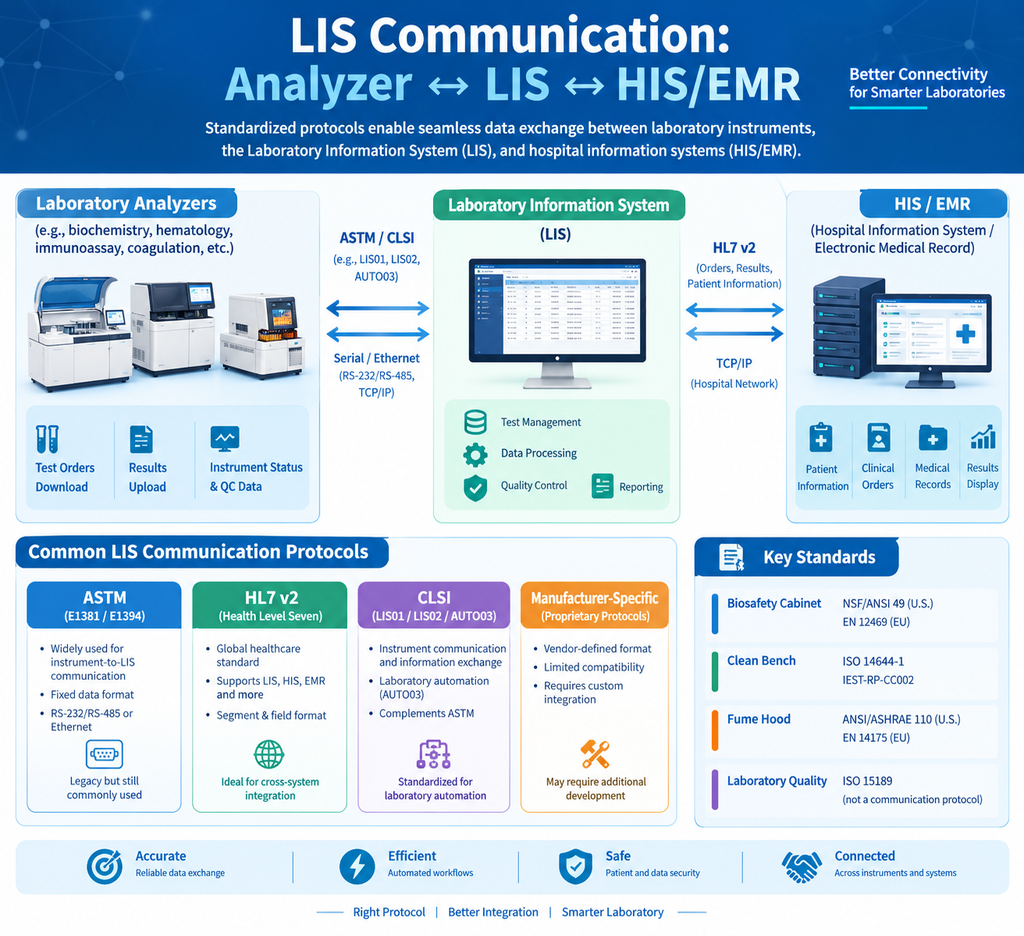
A Laboratory Information System (LIS) connects laboratory analyzers with hospital information systems (HIS), electronic medical records (EMR), and laboratory automation systems.
LIS communication protocols define how these systems exchange test orders, patient information, laboratory results, and quality control data.
Common approaches include ASTM-based interfaces, CLSI standards, HL7 messaging, and manufacturer-specific protocols.
1. ASTM: Laboratory Instrument Communication
ASTM E1381 and E1394 are legacy specifications widely encountered in clinical laboratory instrument interfaces.
- ASTM E1381: Focused on low-level data transmission, including frames, acknowledgements, and error handling.
- ASTM E1394: Defined the structure and content of laboratory messages.
These specifications were later transferred to CLSI. Related standards include CLSI LIS01 and LIS02.
When connecting an existing analyzer, check the exact protocol supported by both the instrument and the LIS.
2. HL7: Connecting LIS and Hospital Systems
Health Level Seven (HL7) is a healthcare data exchange standard. HL7 Version 2 (HL7 v2) is commonly used to connect LIS, HIS, and EMR systems.
It supports the exchange of:
- Patient information
- Laboratory orders
- Specimen information
- Test results and flags
- Order and result status
Successful integration requires compatible message formats, field mappings, and communication settings.
3. CLSI: Standards for Laboratory Connectivity
The Clinical and Laboratory Standards Institute (CLSI) publishes standards for laboratory instrument communication and automation.
| Standard | Main Purpose |
|---|---|
| CLSI LIS01 | Low-level communication |
| CLSI LIS02 | Information and message exchange |
| CLSI AUTO03 | Communication in laboratory automation systems |
These standards support instrument connectivity and laboratory workflow integration. The applicable edition and implementation requirements should always be verified.
4. Manufacturer-Specific Protocols
Some analyzers use proprietary communication protocols or customized message formats.
Integration may require manufacturer documentation, custom software, test-code mapping, and error-handling procedures.
Before purchasing an analyzer, confirm its available interfaces and compatibility with your LIS.
5. ASTM vs. HL7 vs. CLSI
| Protocol or Standard | Typical Application |
|---|---|
| ASTM-based interface | Legacy analyzer-to-LIS connections |
| CLSI LIS01/LIS02 | Instrument communication and data exchange |
| HL7 v2 | LIS, HIS, and EMR integration |
| CLSI AUTO03 | Laboratory automation |
| Proprietary protocol | Manufacturer-specific interfaces |
Note: RS-232 and Ethernet are connection methods, not LIS message protocols. ISO 15189 is a medical laboratory quality and competence standard, not a communication protocol.
6. How to Choose the Right Protocol
Before integrating a laboratory analyzer with an LIS:
- Check compatibility: Confirm the protocols supported by the analyzer and LIS.
- Confirm connectivity: Identify the supported serial or network connection.
- Map data: Match specimen IDs, test codes, units, and result flags.
- Define workflows: Confirm order download, result upload, and bidirectional communication requirements.
- Test the interface: Verify data accuracy, error handling, and recovery from communication interruptions.
Conclusion
ASTM-based interfaces, CLSI standards, HL7 messaging, and proprietary protocols all play important roles in laboratory connectivity.
The best choice depends on the analyzer, LIS capabilities, and hospital information architecture. Proper interface mapping and validation are essential for accurate and reliable laboratory data exchange.
Further Reading: